By Dan, GSR US team. Published .
For a full swing, plan on a space at least about 10′ wide, 15′ deep and 9′ high inside the shed. Around 11.5′ × 16.5′ with a 9.5′ ceiling is more comfortable. Those are the figures GSR works to for a full swing, and they decide the smallest shed that works.
Everything beyond that is about how you want to use the building. Do you want a sofa behind the golfer, room for friends to watch, or space for left- and right-handed players? This guide walks through GSR's three golf shed sizes against those figures, so you can see what each one leaves you once the swing has its room.
The swing decides the minimum
A golf simulator shed is built around one thing, a full swing with a driver that never touches a wall or the ceiling. Three measurements matter.
- Width gives the club room through the backswing and follow-through on both sides of the golfer.
- Depth covers the distance from the hitting mat to the impact screen, plus room behind the golfer for the backswing.
- Height clears the top of the swing and leaves room for anything mounted on the ceiling, such as the projector or an overhead launch monitor.
GSR's minimum of about 10′ × 15′ × 9′ is the space where a full swing fits. The comfortable 11.5′ × 16.5′ with 9.5′ of height gives the swing and the equipment some breathing room. Taller golfers and long swings use more of that margin, so plan for the tallest person who will play.
GSR's three golf shed sizes
GSR's golf sheds come in three sizes. Here is how each one compares with those figures.
Small, 10′ × 16.6′
The Small shed is about 166 sq ft. Its width matches the 10′ minimum and its depth of 16.6′ is a little more than the comfortable 16.5′. It suits one hitting bay with the golfer, the screen and the technology, and not much else. If you mainly want somewhere to practice on your own, it does the job.
Medium, 13.3′ × 20′
The Medium shed is about 266 sq ft. It is about 1.8′ wider than the comfortable width and about 3.5′ deeper than the comfortable depth. That extra depth can hold seating behind the golfer, so someone can sit and watch without standing in the swing path.
Large, 16.6′ × 23.3′
The Large shed is about 387 sq ft. It is about 5′ wider and nearly 7′ deeper than the comfortable size. That is room for a proper seating area, storage for clubs and a group of friends, with the bay still clear.
What a real 14′ × 20′ golf shed looks like
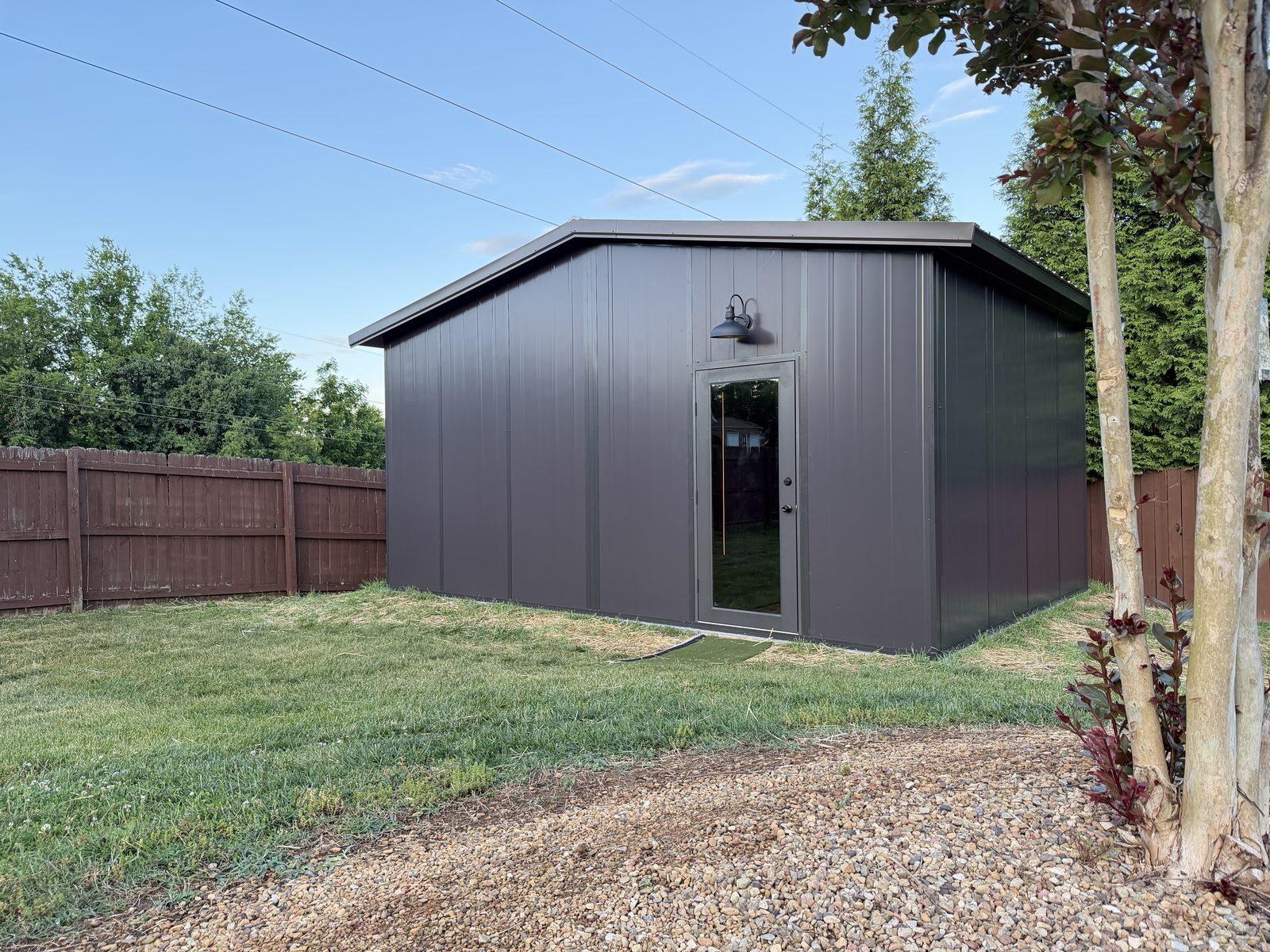
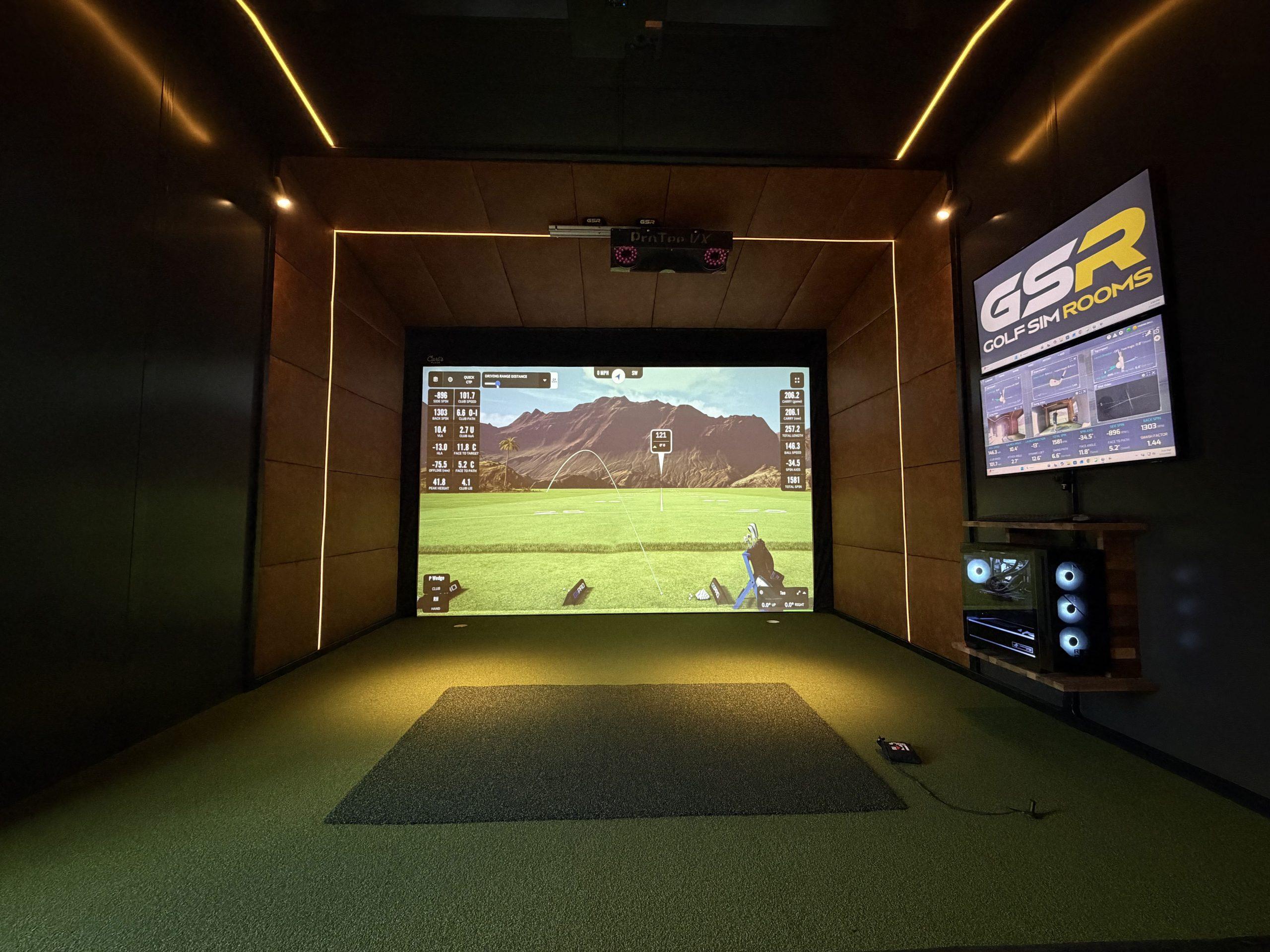
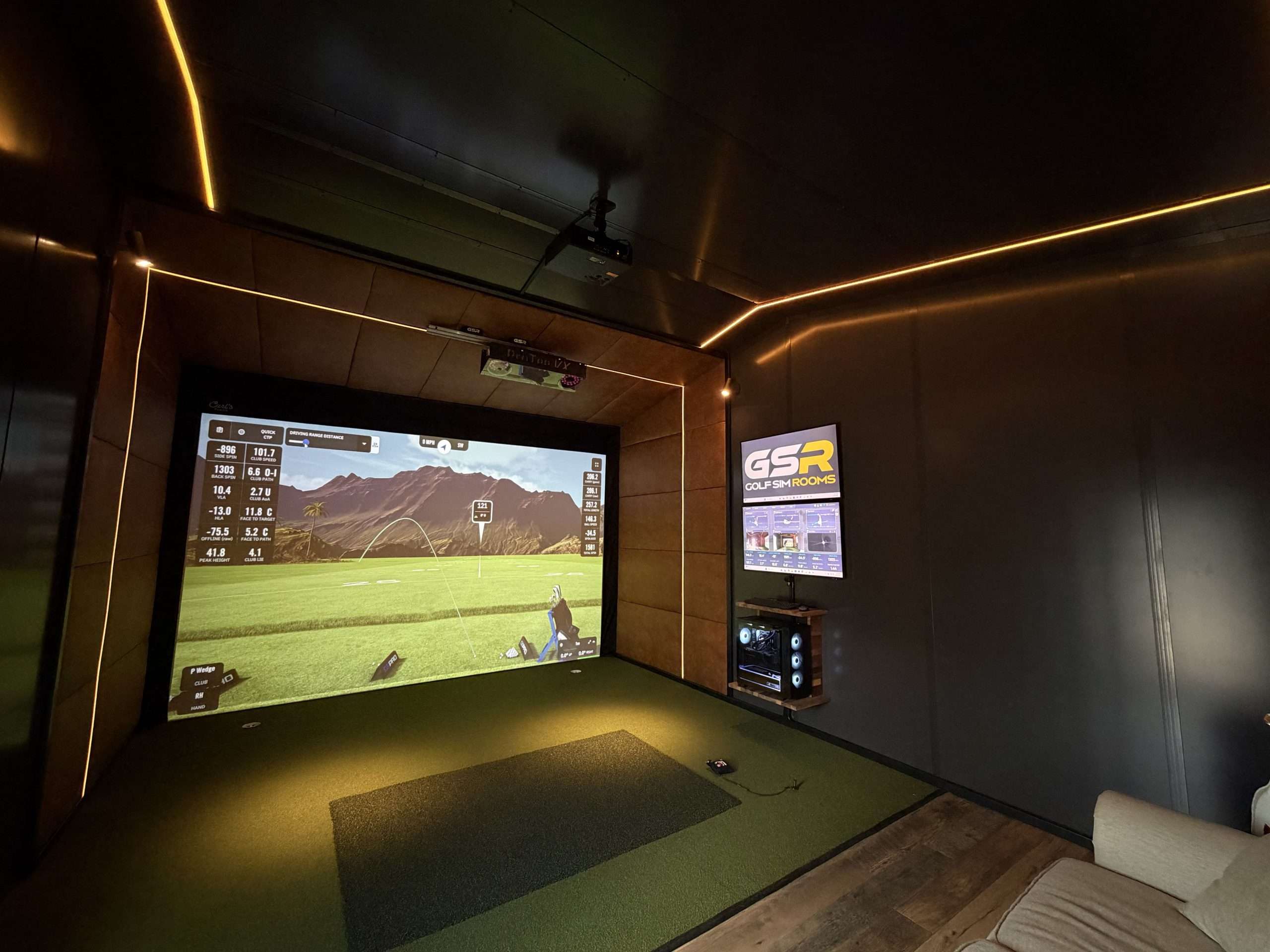
The golf shed GSR built in Lafayette, Louisiana is 14′ × 20′, which is 280 sq ft. From the outside it is a black steel building in a landscaped backyard. Inside, the screen is framed in wood, the bay is lit with amber LED strips, and there is room for a sofa beside the hitting area.
It sits between the Small and Medium sizes, and it shows what the space beyond the swing is for. For comparison, the open-front enclosure GSR built for Nate Diaz in Lodi, California is 17′ × 15′, wider than any of the three sheds but less deep.
Height matters as much as the floor plan
Floor area is the number people compare, but in GSR's experience ceiling height is the most common reason a planned spot changes partway through a project. The top of a driver swing needs clear space, and the ceiling also carries the projector and, often, the launch monitor.
Overhead launch monitors hang from the ceiling in front of the ball. ProTee's own support guidance for its VX launch monitor recommends mounting it 9′ to 10′ above the hitting surface. It says a lower ceiling risks club interference and a higher mount may reduce accuracy. Foresight's Falcon, another overhead unit on GSR's US technology list, reads a hitting area of 59″ × 28″ beneath it, so the mat has to sit in the right place under the unit.
If you prefer a launch monitor that sits on the floor beside the ball, such as Foresight's GC3, nothing hangs over the ball, though the ceiling still has to clear the swing and the projector. Either way, the height inside your shed should be settled before the floor plan.
Think about who will play
A shed that suits one golfer practicing alone is different from one built for a family or a group.
- Left- and right-handed players. If both will use the simulator, tell us early. It affects where the hitting mat goes and where an overhead launch monitor is mounted.
- People watching. Seating has to sit well behind the golfer and out of the swing. That is what the extra depth in the Medium and Large sheds is for.
- More than golf. If you want the building for watching games, kids' practice or an evening with friends, the extra space makes it a room rather than a bay.
The size also affects your permit
Floor area is one of the first things a building department asks about. The model residential code most US towns build on exempts small one-story accessory buildings up to 200 sq ft, and many towns use 120 sq ft instead. GSR's Small shed is under 200 sq ft, the Medium and Large are over both limits, and the power a simulator needs can bring a permit of its own. Check whether you need a permit for a golf simulator shed before you settle on a size.
What comes inside every size
The size changes the space, not the package. Every GSR golf shed comes with the complete building, the full simulator fit-out, delivery and installation. The building is 26-gauge Galvalume steel with a 3.5″ insulated core and 2″ insulated floor panels. Inside you get leather wall panels with a white LED surround, a dual-layer impact screen, putting-grade turf, a strike mat, two 43″ 4K displays and a soundbar. You add your choice of launch monitor, projector and PC.
When a shed is more than you need
If your yard cannot take even the Small shed with room around it, or you already have a garage or basement with enough height, a new building may not be the best use of your money. A garage conversion or a golf simulator room in a spare room or basement uses the same swing figures and needs no new structure. Measure the width, depth and height first, and compare them with the figures above.
Conclusion
The swing sets the minimum at about 10′ × 15′ × 9′, and 11.5′ × 16.5′ with a 9.5′ ceiling is more comfortable. GSR's Small shed covers one golfer practicing. The Medium adds room to sit and watch, and the Large turns the shed into a room for a group. Settle the height and the launch monitor alongside the floor plan, and check your local permit rules before you choose.
If you are deciding between sizes, start your project with Golf Sim Rooms. Tell us your yard's dimensions, who will play and your state, and our US team will recommend the size that fits. Most inquiries get a reply within one business day.